

I Didn’t Have to Wait Forty Years. Neither Do You.
Sand Springs, Oklahoma. 1978.
I was twenty-three years old, five years into my marriage to the preacher-man, mother of a three-year-old, and living a life built entirely out of what I should do, what I might do, what was expected of me.
Wanting was not on the list. Wanting, in that life, would have been unforgivable.
Here’s something I didn’t know about being a minister’s wife in Sand Springs, Oklahoma in 1978:
The local Women’s Club had it written into their charter that all ministers’ wives were automatic members.
Automatic. No application required. No choice in the matter.
So I went. Once.
The one time I chose to attend their gathering — the one and only time — happened to be the day they were all going to the movie theater to see a newly released film.
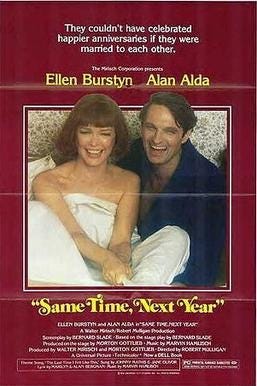
Same Time Next Year.
Thank God.
Because I knew — knew — I could not sit in someone’s perfectly decorated parlor nibbling petit fours off a china plate with a lace napkin on my lap pretending to belong.
At least I got to see a movie.
Same Time Next Year stars Ellen Burstyn and Alan Alda as two people who meet by chance on the California coast, spend one night together, and make a promise to meet again — same place, same weekend — every year.
What caught me wasn’t the romance.
It was Ellen Burstyn’s character.
When they first meet in the 1950s she’s the perfect picture of a stay-at-home wife. Heels. Pearls. Polite smiles. The whole performance.
But year after year, scene after scene — she grows.
Her clothes change. Her language sharpens. Her energy expands. By 1978 she’s running her own catering business — a woman transformed so completely she’s barely recognizable as the woman who started the story.
And I sat there in that movie theater in Sand Springs, Oklahoma, twenty-three years old with a lace napkin credit and a life that didn’t fit —
and something inside me woke up.
This could change. I don’t have to stay here.
Not “here” as in Sand Springs. Here as in — this version of myself.
That movie planted a question I would carry for the next forty years:
How do I grow? How do I become someone I can actually respect?
The search that followed was long. Winding. Sometimes genuinely painful.
I left Sand Springs. Left the first marriage. Found my way to New York City and a concert pianist and a decade of a completely different kind of life. Found my way back south to another minister and another version of myself.
Along the way I was a music producer, a talent manager, a published writer. I owned a small online newspaper. I had dinner with Gorbachev. With Nixon. With Madeleine Albright.
I would ask them — these larger-than-life people across the table — how they’d built the lives they had. None of their answers were particularly memorable. But they all had one thing in common.
They just knew. Without doubt. They knew they were on a mission.
I was still looking for mine.
That’s when the self-help books started.
By the time my house in Washington D.C. burned down, I had a library of over six hundred of them.
Six hundred.
I’d read every one. Devoured them, convinced the next chapter, the next tool, the next revelation would finally unlock the thing I couldn’t quite name.
I say this with complete affection for the genre and zero regret about the money spent:
The self-help industry was my original codependent relationship.
I had the books, the life coach, the tools, the frameworks, the morning routines. I was committed to growth the way some people are committed to a second job.
And still. It wasn’t quite enough.
Because I was consuming everyone else’s answers to a question only I could answer for myself.
It wasn’t until I lost nearly everything that I finally got quiet enough to hear it.
No house. Depleted resources. No one to lean on. No sense of safety — not physically, not financially.
Just me.
And my cat.
That’s when I stopped.
No announcements. No declarations. No new program or framework or guided meditation series.
I just shuttered the windows — not to block the world, but to soften it — and stayed in.
In the evenings, the moon kept me company.
In the mornings, the birds.
And in that particular quiet — the kind that only arrives when you’ve stopped filling the silence with other people’s wisdom — I finally heard something I hadn’t in years.
My own voice.
Not the preacher’s wife voice. Not the New York voice. Not the voice trained by six hundred books to speak in someone else’s framework.
Mine.
Here’s what it said, when I finally got quiet enough to hear it:
You already know.
You’ve always known.
You’ve just been very, very busy asking everyone else.
Just like Ellen Burstyn’s character — that woman who transformed herself year by year, scene by scene, until she was barely recognizable as the woman who started the story — I realized time wasn’t my enemy.
It was my material.
Every marriage. Every city. Every book. Every dinner with a world leader who turned out to have no better answers than anyone else. Every moment of starting over.
All of it was the painting.
I just hadn’t stepped back far enough to see it.
I’m telling you this today — one year after I first told it — because something has settled in the telling.
I spent forty years searching for what was already inside me.
Forty years of books, coaches, frameworks, programs, conversations, moves, marriages, and one very significant house fire.
And what finally worked?
Getting quiet.
Sitting with myself.
Listening for the voice underneath all the noise I’d been calling guidance.
You don’t have to wait forty years.
That’s not a sales line. That’s the thing I most wish someone had said to me in that movie theater in Sand Springs in 1978, when I was twenty-three and something in me woke up and I had absolutely no idea what to do with it.
Start quieter than you think you need to.
Listen longer than feels comfortable.
And trust that what’s been waiting underneath all the noise —
has been there the whole time.
If something in this story stayed with you — if you felt the recognition before you felt the words for it — I want you to know there’s a place for that.
I’ve been quietly building something called the Monirose Soul Circle. It’s a small group of women who are done waiting for their life to feel like theirs again. Not a support group. Not a place to process pain, though we understand it. A place to think out loud with women who have lived enough to know what they’re talking about — and who want peers, not cheerleaders.
We share what’s true. We ask the real questions. We hold each other to the version of ourselves we’re trying to grow into, not the version we’ve been performing.
If you’re just beginning to understand that you’re allowed to want what you want — that’s exactly the right moment to come in.
You don’t need to have it figured out. You just need to be done pretending you don’t care.
Come see if it feels like home.
I spent forty years and six hundred self-help books finding my way back to my own dream.
I made this so you don’t have to.
The Re-Claiming Dreams Roadmap. Ten steps. One PDF. Considerably fewer decades required.
Get the Roadmap here →Re-Claiming Dreams Roadmap
And if something in this piece made you pause, nod, or feel a little less alone — please give it a heart before you go. That one small tap tells the algorithm this conversation matters. It puts these words in front of another woman who needs to hear them today. She's out there. Help me find her.
Thank you for your post — yes, the twenty-three year old wife, me too.
What a life I led at that age being the backup and supporter of my husband following “His Dream” for four years of schooling, etc. I definitely bought into a role that has defined a big part of my life … long story, but with many, many defining moments of being the backstory in our family.
I did keep worlds of myself alive within … well now, they’re emerging as I let go of many patterns. Your writing and that of others fuels me. Thanks to all!! 🧡
Freeing insights for me …
“Because I was consuming everyone else’s answers to a question only I could answer for myself.”
“… in that particular quiet — the kind that only arrives when you’ve stopped filling the silence with other people’s wisdom — I finally heard something I hadn’t in years. My own voice.“ 💡
I hope that my own voice is one that “I” come to enjoy … value … treasure … and never abandon.
Thank you, Monica!