


The glimmer opened something in her, and through that tiny door a memory drifted in—uninvited, but somehow right on time.
It wasn’t one of the big memories. Not the heartbreaks, not the disappointments, not the milestones.
Just a sliver of a Sunday afternoon from a lifetime ago.
Her mother, standing at the kitchen sink, elbows deep in suds. The window cracked open to let out the steam. The radio humming some old tune about a woman waiting for a man who never came home.
Clara could see it as clearly as if she were eight years old again. Her mother scrubbing a plate a little too hard, muttering under her breath—not angry, just tired.
“Rest is a luxury.”
She’d said it to the air. To herself. To whatever invisible judge she lived with in her head.
Clara remembered the sting of those words. How fast she sat up straighter on the counter stool, like she’d been caught doing something shameful by simply being still.
And now here she was, decades later, curled in her green chair, feeling the echo of that same old script humming under her skin.
Rest is a luxury. Be useful. Earn your place. Don’t sit too long.
No wonder stillness felt like something she had to apologize for.
She exhaled slowly, letting the memory settle instead of trying to push it away.
Maybe this was the thing she’d been circling without knowing it. Not fear of the future. Not confusion about who she was becoming.
But the simple, bone-deep truth that she had never learned how to be still without feeling like she was breaking a rule.
The room felt different now—softer, but heavier too. Like the air itself was waiting to see what she’d do with this realization.
Clara pulled the blanket up over her knees and let herself sit in the discomfort.
What if her mother had been wrong?
What if rest wasn’t a luxury, but an invitation?
What if she could rewrite that old rule?
The questions rose in her like sparks, lighting corners of herself she’d never bothered to explore.
Outside, the light shifted across the orange rug again. This time, it didn’t look like a flirtation.
It looked like a possibility.
And that possibility sparked something unexpected: curiosity. Fun, even.
So she decided to make a game of it. A practice of sorts.
She’d read somewhere—or maybe seen it in a video—about a simple breathing pattern. Four counts in. Hold for four. Six counts out.
It seemed manageable. Small enough not to be intimidating.
She began with just two minutes at a time, once a day. Sitting in her green chair. Closing her eyes. Breathing.
In, two, three, four. Hold, two, three, four. Out, two, three, four, five, six.
At first, her mind wandered. Grocery lists. Errands. The drip in the bathroom sink she kept meaning to fix.
But she kept returning to the breath.
In, two, three, four. Hold, two, three, four. Out, two, three, four, five, six.
After a few days, she found herself thinking, Hm. This is easy. So she added a few more minutes. Then twice a day.
Something remarkable began rising within her.
She noticed it first as calm. An actual, physical softness in her chest she hadn’t felt in years.
Her shoulders dropped.
Her jaw unclenched.
The constant hum of low-grade anxiety—the one she’d lived with so long she’d stopped noticing it—began to quiet.
Then one afternoon, sitting in her green chair with the light slanting through the window, she opened her eyes after her practice and laughed out loud.
“So THIS is what it feels like,” she said to the empty room. “To live with peace. Without anxiety.”
She sat there, stunned. I had no idea.
The thought alone sent goosebumps rippling up and down her spine.
I feel good.
For no other reason at all. Just… good.
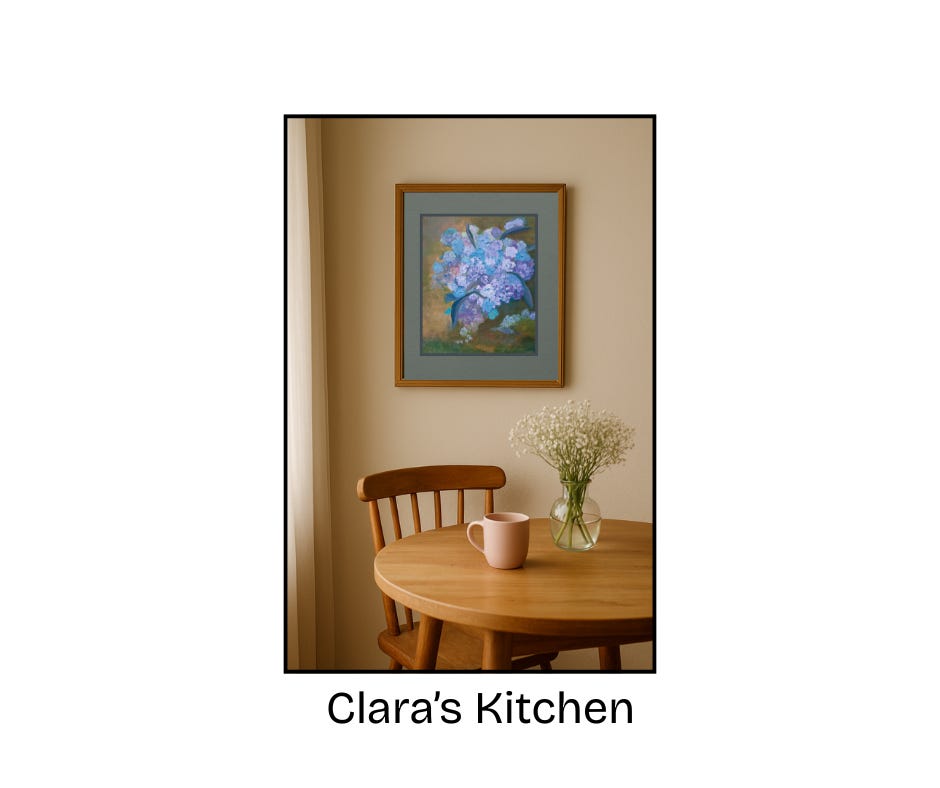
She stood then, almost without thinking, and wandered over to the shelf where she kept the few things she’d collected over the years but never really let herself enjoy. And there it was—the painting she’d bought at a small local art show months ago and promptly tucked away, telling herself she didn’t need it, didn’t deserve it, didn’t have space for it.
Hydrangeas in blues and violets, rising out of a soft, earthy background. Wild. Unarranged. Blooming anyway.
She remembered the moment she bought it. How something in those flowers had made her feel steadier, like they were whispering that beauty didn’t have to be earned.
On impulse, she carried it to the wall above her kitchen table and hung it there.
The room changed immediately.
She changed immediately.
It was the first thing she’d chosen in years that hadn’t been practical or frugal or meant for someone else. It was hers—fully hers.
And somehow, looking at it, she could imagine a life where beauty wasn’t an accident. It was a choice she could keep making

.