


JULY 21, 2026
Oh Look. Another Purity Test.
Today, Substack announced a new tool that will allow readers to scan writing and receive an estimate of how much of it may have been written with AI assistance.
MY immediate response: oh look. Another purity test.
Because that is what this becomes: the moment a machine gets trusted to determine whether a human being is authentically present in her own work.
A purity test is judgment. Full stop. Someone else creates a moral standard, and the rest of us get to prove we’re clean enough, authentic enough, human enough, progressive enough, traditional enough — whatever flavor of purity happens to be required that day.
Did you write every word yourself? Did you use AI? How much? Did AI make the sentence too polished? Did you suffer sufficiently and alone over the blank page? At what precise percentage does the writing stop belonging to you?
Get “da fuck” outta here……….
A detection tool might estimate whether AI was involved in producing a piece of text. What it cannot tell you is who had the original thought. Who lived the experience. Who spoke the story aloud, rejected the first version, changed the argument, removed the bad language, restored the humor, moved the paragraphs, rewrote the ending, and edited the entire thing again on the Substack page.
It cannot tell you who supplied the life.
Seventy years old, and using AI. There. Said it.
ChatGPT, Claude, bouncing between both — speaking thoughts into one, carrying the result to the other, arguing, revising, combining, rejecting, reshaping, moving the piece into a document, rewriting it again. Often more changes happen after it’s pasted into Substack, changes that exist nowhere except on that blank publishing page and inside one particular mind.
Never once has the process been “write something about fatigue” followed by publishing whatever comes back. It begins with something lived, noticed, questioned, resisted, remembered, or finally understood.
The thought is mine. The story is mine. The judgment is mine. The humor is mine. The decision to publish is mine.
AI helps take something nebulous and press against it until what I actually think becomes visible. It doesn’t replace the thinking. It refines it, challenges it. Sometimes it hands back language too smooth, too obedient, too generic, and that language goes straight into the trash where it belongs. Sometimes it names the beating heart of something circled for an hour. Sometimes it’s wrong. Sometimes I’m wrong. Then the work continues until the piece says what it means.
That’s not the absence of authorship. That’s an editorial process.
Writers have always used tools — editors, researchers, transcriptionists, dictionaries, thesauruses, writing groups, workshops, dictation, spell-check, and the opinions of every friend unfortunate enough to answer the phone mid-sentence-wrestling-match. Now some of us also use AI.
The tool changed. Human responsibility didn’t.
Yesterday, an article went through several rounds of conversation and editing with both ChatGPT and Claude before one more revision, by hand. Today, a reader sent flowers because of the emotion and connection she felt reading it

.
A machine did not live that story. A machine did not receive those flowers.
For eighteen months, this exact evolving process has been the process. Not one reader has ever accused any of it of being soulless AI slop. Not one reader has said there was no human being behind the writing. Readers seem perfectly capable of recognizing when a real woman is present — because authenticity was never a sentence construction, a punctuation pattern, or a score. It’s the presence of a human consciousness willing to stand behind what she’s said.
And now there’s a tool to help determine whether someone is authentic.
Think about the absurdity of that. Outsourcing discernment about human authenticity to an algorithm, rather than reading the work, observing the writer over time, noticing whether the ideas are coherent, whether the stories feel lived, whether the voice stays consistent. Rather than staying curious. Just pressing a button and receiving a percentage.
How wonderfully efficient. How completely devoid of context.
We used to say don’t judge someone until you’ve walked a mile in her shoes. Now apparently we scan the shoes and ask software whether she really walked in them.
Judging without the facts has always provoked a visceral reaction here. It’s why pile-ons get resisted. It’s why joining the public stoning of someone because a crowd has decided it possesses the whole truth has never once felt right. Discernment gets built through effort — through learning to trust one’s own gut, knowing when something resonates with truth and when something feels false.
That discernment isn’t getting handed over to a scanner. Nor is there any interest in jumping through another purity hoop to satisfy someone else’s moral criteria.
Purity tests are everywhere now. Politics. Social movements. Art. Language. How enthusiastically the correct position gets embraced, how forcefully the correct person gets condemned. And now, apparently, how much mechanical assistance is permitted before humanity itself becomes questionable.
Being judged for what I am is exhausting. Being judged for what I’m not, more exhausting still. Being asked to prove innocence to people who haven’t bothered learning the facts, most exhausting of all.
Particularly amusing: embracing new tools with curiosity at seventy, while some younger people stand at the gate shouting “She used AI!”
Yes, darling. Guilty. Also used a computer. Dictated rather than typing. Wrote in Google Docs. Published through Substack. Used electricity.
None of those things authored this life.
Transparency is one thing. Turning authorship into a purity test is another.
The presence of AI does not prove the absence of a human.
And no algorithm on Earth can measure the flowers sitting in this apartment today.
Irreverently, always.
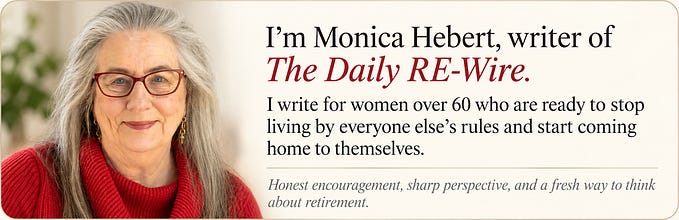
Monica
If sassy, irreverent articles from a seventy-year-old woman embracing every bit of what life still has to offer — and redefining retirement while she's at it — sound like good company, by all means, come join us.
PS If you are like me, you don’t like PURITY tests, then please consider hitting the like button and then re-stacking so that others can be part of the fun. Thanks!
So it's begun "Artificial Intelligence" telling all of us who and what is human and what is not!
What I find hilarious about this new "tool" is that so few people will use it here. Readers and writers who are looking for and bringing authenticity and connection can read it, feel it, hell we can smell it from a mile away! Do I give a flying F if you had editing help from a person or machine? I do not. Do I know if writing seems off in some way and therefore I'm not interested? I sure do. Plus who has time for this???