

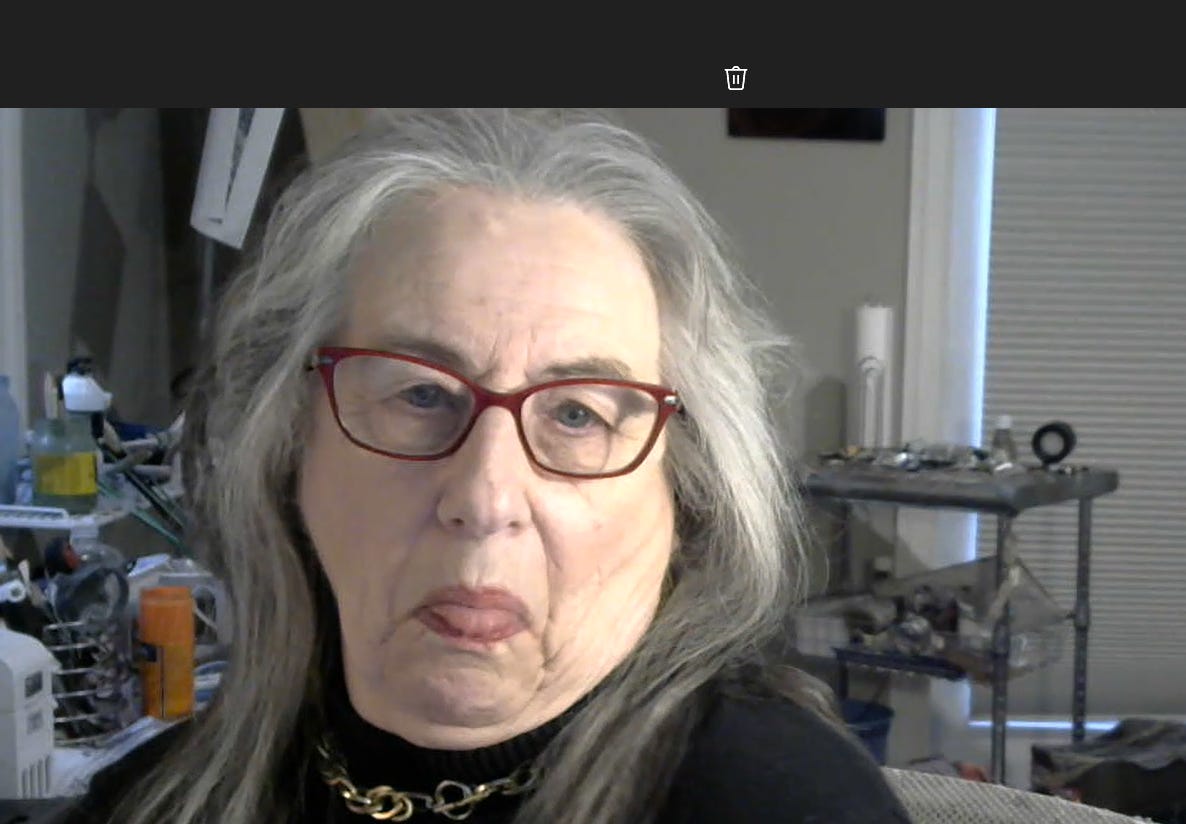
This is what retiring from "supposed to" looks like.Not serene. Not floating in white linen.Just done.The Trap of “Supposed To”
( This is not about the roles that felt true. This is about the ones that were handed to you and you forgot to ask whether they fit.)
Yesterday I collided with two words.
Not a person. Not a crisis. Not some grand spiritual thunderclap from the clouds.
Two words.
Supposed to.
And once I saw them, I could not unsee them.
You are supposed to do this. You are supposed to care about that. You are supposed to show up this way. You are supposed to want this kind of life. You are supposed to have this kind of home. You are supposed to be this kind of mother, grandmother, woman, citizen, neighbor, retiree — whatever little costume the world is trying to button up around your neck.
And I thought: wait a minute.
According to who?
That is the question that has started setting off fireworks in my head.
Because “supposed to” sounds so reasonable. That is how it gets in.
It does not usually arrive screaming. It does not kick down the door with a villain cape and dramatic music.
It walks in wearing sensible shoes, carrying a casserole, acting like it has always belonged there.
You are supposed to put shelf paper in the cabinet.
You are supposed to wash your hair before you go out.
You are supposed to care what the house looks like.
You are supposed to behave a certain way because it is Saturday.
You are supposed to have plans because it is the weekend.
You are supposed to recognize the weekend as if the calendar still owns the emotional meaning of your life.
But here is the funny thing about being a woman over sixty — especially if you are retired or semi-retired or living in that strange new chapter where Monday feels like Saturday and Saturday feels like Tuesday wearing lipstick:
The old calendar starts losing its authority and the weekend does not mean what it used to mean.
Saturday is no longer the reward for surviving the workweek, with Sunday no longer the countdown to Monday dread.
Monday is no longer the starting gun.
The whole structure begins to wobble.
And once the structure wobbles, all the “supposed to” rules that were attached to it start looking a little ridiculous — standing there with no job to do.
You are supposed to do something fun because it is Saturday. Why?
You are supposed to be productive because it is Monday. Why?
You are supposed to get dressed by a certain time. Why?
You are supposed to get out more. Why?
You are supposed to keep things looking normal from the outside. Why?
You are supposed to have a life that other people recognize as full. Why?
That is where the whole thing begins to crack open.
Because “supposed to” is often just inherited authority nobody ever verified.
It feels like logic. It feels like structure. It feels like correctness.
But when you dig down far enough, very often there is nothing solid underneath it.
There is just conditioning. Family expectation. Social habit. Fear of looking different. Fear of disappointing someone. Fear of being judged. Fear of not keeping up the appearance of being a good woman, a good mother, a good grandmother, a good citizen, a good little soldier in the army of other people’s expectations.
And I am tired of it. Not tired in a dramatic way.
Tired in a “I have lived long enough to question the damn furniture” way.
Because so much of what we call normal is arbitrary. That is the thing. It is all so freaking arbitrary.
And yet we build whole lives around it.
We do things because that is what mothers are supposed to do. We keep traditions because that is what families are supposed to keep. We show up for things because that is what good people are supposed to do. We maintain relationships because that is what loyal people are supposed to maintain. We agree to roles because someone somewhere handed us a script and we forgot to ask whether we wanted the part.
And then we arrive in later life wondering why we feel tired, foggy, restless, resentful, or oddly disconnected inside lives we technically did “right.”
Maybe we are not tired because we are aging.
Maybe we are tired because we have been obeying.
That is the part I want to look at.
Not rebellion for the sake of rebellion.
I am not suggesting we all run down the street in our bathrobes throwing etiquette books into traffic.
Although, depending on the day, I might watch.
I am talking about something deeper. I am talking about the moment a woman begins to reclaim authority over her own life.
Because “supposed to” does not guide you.
It limits you.
It says: do not question. Do not deviate. Do not listen inward. Do not ask what feels true. Do not ask what your soul is saying. Do not ask whether this still fits the woman you are now.
It replaces what do I want? with what is expected of me?
And that is a quiet kind of theft.
No one calls it theft, of course. They call it responsibility. They call it maturity. They call it family. They call it tradition. They call it being realistic. They call it aging gracefully — which too often means aging quietly, politely, and without making anyone uncomfortable with your sudden possession of opinions.
But I have reached the point in my life where I am deeply suspicious of every sentence that begins with you’re supposed to.
Because I did many of the things I was supposed to do.
I played by rules I did not write,I followed scripts I did not examine. I carried expectations I did not create.
And I have earned the right to ask: did those rules deliver what they promised?
That is not bitterness. That is clarity. There is a difference.
Bitterness says nothing was worth it.
Clarity says I am no longer willing to keep paying rent on a belief system that never belonged to me.
That is where I am now.
I do not think of my life as retired. Not really. The word has never felt quite right in my mouth.
I think of myself as a woman who has retired from obligation.
Retired from automatic obedience.
Retired from being managed by “supposed to.”
Retired from organizing my days around what someone else might think a woman my age should want, need, do, or become.
And that is very different.
Because retirement, as the world often frames it, can sound like a closing down.
But retiring from “supposed to?”
That is an opening.
That is where a woman gets to ask a question she may not have had room to ask for decades:
What is actually true for me now? Norwhat was true twenty years ago,not what made sense when the children were young or not what kept the marriage functioning.
Not what fit the job.
Not what made the family comfortable.
Not what proved I was good.
What is true now?
That question changes everything.
It changes how you move through a day. How you spend your energy. What you keep and what you release. How you look at your home, your routines, your relationships, your body, your work, your dreams, your quiet, your solitude, your money, your time.
It even changes how you experience a Saturday.
Because if there is no longer a rule that says Saturday must mean something in particular — then Saturday becomes available.
It becomes yours.
Maybe Saturday is errands.
Maybe Saturday is painting.
Maybe Saturday is sitting near the balcony with coffee, staring at a tree and letting your life come online slowly.
Maybe Saturday is doing absolutely nothing that looks impressive from the outside.
Maybe Saturday is not a performance.
Imagine that.
A day not ruled by “supposed to.”
A day shaped by listening.
That is the life I am interested in now.
Not a perfect life. Not a tidy life. Not a life where I float around in white linen pretending I have transcended irritation, bills, laundry, and people who get on my nerves.
Please.
I am still me.
But I want a life where I notice the moment “supposed to” tries to take the wheel.
I want a life where I pause before obeying; life where I can hear the old instruction and ask: Why?
And even more importantly: What happens if I don’t?
That question is dangerous in the best possible way.
What happens if I do not live according to that rule anymore?
What happens if I do not keep making decisions from old fear?
What happens if I do not perform the role just because people are used to seeing me in it?
What happens if I stop asking what I am supposed to do and start asking what my soul is trying to show me?
That is where the rewire begins.
Not in some dramatic overhaul.
Not in a ten-step plan.
Not in a new planner, new system, new color-coded life strategy — God help us all.
It begins in the tiny pause between the old command and the new choice.
You hear the phrase: you are supposed to.
And instead of automatically obeying, you stop.
You ask why.
You ask who benefits.
You ask whether it still fits.
You ask whether the woman you are now wants to keep living under that instruction.
That is not selfish.
That is sovereignty.
And sovereignty, it turns out, looks a lot like a woman who finally stopped apologizing for taking up space in her own life.
I think this may be one of the great gifts of later life — if we are brave enough to accept it.
The old structures loosen.
The roles shift.
The calendar changes.
The outside demands may quiet down.
And in that space, we can either panic because nobody handed us a new script — or we can finally admit that the script was never the source of our life in the first place.
Maybe we do not need a new set of “supposed to” rules for retirement.
Maybe we need to become women who know how to listen.
Women who know how to question.
Women who can tell the difference between wisdom and conditioning.
Women who can say: that may be common, but it is not my command.
Women who can stop outsourcing their authority to family, culture, tradition, politics, algorithms, experts, adult children, old roles, or that bossy little voice in the head that still thinks it is 1987 and everyone needs dinner by six.
This is not about rejecting everything.
It is about choosing consciously.
When a woman starts questioning “supposed to,” people may think she has become difficult.
No.
She has become awake.
She is not abandoning her life.
She is returning to it.
She is returning authority to the person actually living the life.
And maybe that is why these two little words hit me so hard.
Because once you see them, you start hearing them everywhere.
In family expectations. In aging expectations. In retirement expectations. In the way people talk about what someone should have done, should be doing, should know better than to do, should care about, should prioritize, should sacrifice, should accept.
And underneath so much of it is the same brittle little assumption:
There is one correct way to live.
No, thank you.
I am not interested in spending the rest of my life trying to be the correct version of an older woman.
I want to be the true version.
Even if the true version occasionally skips Saturday plans, talks to her painting, and considers a nap a spiritual practice.
That may look quiet.
It may look strange.
It may look inconsistent.
It may look like working on a painting one day and doing nothing the next.
It may look like staying home when someone else thinks I should go out.
It may look like building a life that would make no sense to a committee — but makes complete sense to my soul.
That is enough for me.
So this is the question I am carrying now:
Where in my life am I still obeying “supposed to” without checking whether it is true?
And maybe that is the question for all of us.
Not because every rule is wrong.
Not because every expectation is harmful.
Not because we should all become reckless little goblins of personal preference.
But because later life is too precious to keep living from unexamined instructions.
We have earned the right to ask why.
We have earned the right to choose again.
We have earned the right to stop treating inherited expectations as sacred law.
Every time I hear you’re supposed to — I am learning to stop and ask:
Why?
And then, with a little more nerve:
What happens if I don’t?
Because I did not come this far to keep living by rules nobody can explain.
I came this far to finally find out what is true.
If the line “I am no longer willing to keep paying rent on a belief system that never belonged to me” made you sit up a little straighter, I want to tell you about Tuesday evenings.
That’s when a small group of paid members meets with me on Zoom for the Breakthrough Circle.
Not a class.
Not a coach telling you what to do next.
A conversation between women who have started asking why and are figuring out together what to do with the answer.
We question the furniture.
We name the casseroles we’ve been carrying.
We ask what happens if we don’t.
And occasionally, we become reckless little goblins of personal preference together.
In the best possible way.
If this is the conversation you’ve been looking for, it is waiting for you inside.
All paid subscribers are included.
Join us by becoming a paid member today and snag 20% off an annual subscription!
And if something in this piece made you pause, nod, or feel a little less alone — please give it a heart before you go. That one small tap tells the algorithm this conversation matters. It puts these words in front of another woman who needs to hear them today. She's out there. Help me find her.
Considering before doing.
Asking, “Why?” “Why not?”
“Who am I trying to impress?”
I’m almost 70. I have bunions and a bad knee that will get replaced soon. I have lopsided boobs due to an encounter with cancer. My hair is salt and pepper gray.
I wear sensible shoes and I have ALWAYS walked with a limp.
I like loose fitting clothes that don’t confine me. I love wearing bright colors and Hawaiian prints and flowers.
I can be ready to go out within 20 minutes to the theater or out to dinner.
I know how to look 10 years younger in the wink of an eye 😉.
I smile 😃. Yeah - my eyes get more wrinkly, and my laugh lines show 😱. And I look 10 years younger because I feel it within in. I giggle and let the little girl inside me come out and play—UNAFRAID. 🤭🌺✨
Call me eccentric. I will say “thank you.”
I am still finding my bravery. I still have bras in my drawer (I gave up girdles and spanks long ago.). They are worn less often, but still sometimes. OUCH!
I am still finding my voice. And substack is one of my practice fields. 🥰
Keep being brave! Keep being yourself! If “Why?” has a kindness factor, consider it. If “Why?” Has a vanity factor, reconsider it. If “Why not?”has a wonder factor, a new idea factor, a -you’ve always wanted to do this factor, go after it! What are you waiting for!
😘🌺
"Because “supposed to” is often just inherited authority nobody ever verified."
Boy! I could talk for hours on this! How I wish I lived in your neighborhood.
My Catholic, Marine Corp upbringing did a number on me that I am working on shedding. I am NOT going to be swayed by the wagging finger! And I've been having dreams of big cats (panthers, tigers and the like) approaching me to play. It's hard for me to ignore the chores, but life is short and they can often wait. My soul is nudging....no one is keeping score. YES!