

The Life You Expect May Not Be the Life You Have to Live
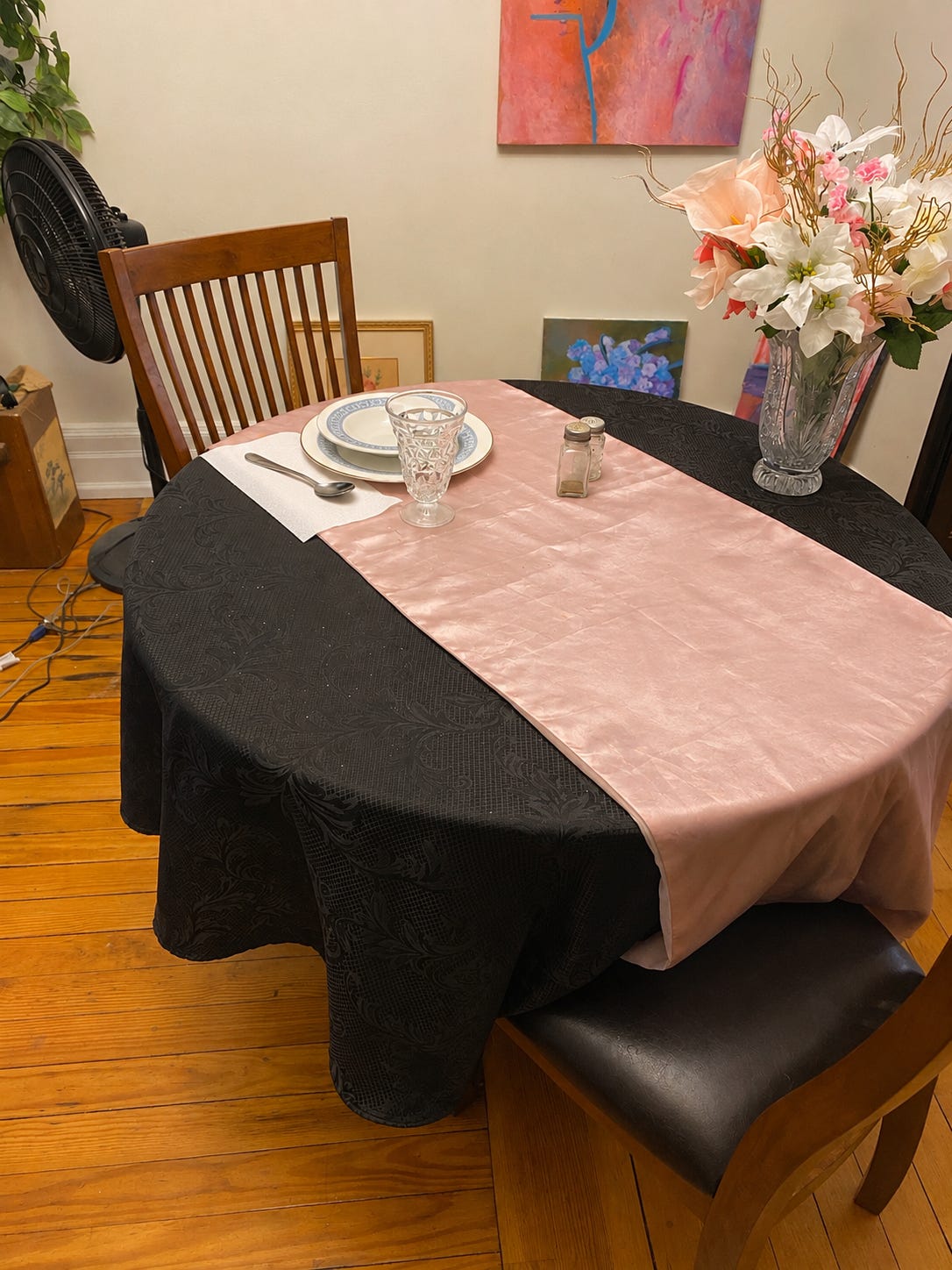
Every evening at 6 o’clock, Elanore set one place at the table. One plate, one fork, one glass, directly across from a chair nobody sat in anymore. When the oven timer went off, she sat down and ate.
She did this for four years after her husband died.
Not because she was hungry. Not because she particularly enjoyed eating at that hour. But because 6 o’clock was when dinner had always been served in that house, and nobody had ever told the house otherwise.
Then one evening, standing at the stove with the timer going off, it occurred to her that she didn’t have to eat at 6 o’clock anymore.
She could eat at 5. She could eat at 8. Hell, she could eat a bowl of cereal in her pajamas at 10 o’clock at night if that’s what she wanted. Nobody was waiting for dinner. Nobody was watching the clock. Nobody was enforcing the rule.
For four years, she had faithfully followed a rule that no longer existed.
When I shared her story on the Notes feed of Substack, women began telling me their own. One said it brought her to tears. Several were struck by how long it took Elanore to see that she had a choice. Another shared a deeply personal story about her childhood and the expectations that followed her into adulthood.
And one woman used a word that stopped me in my tracks.
Subtle.
The conditioning was so subtle that it never occurred to her to question it. She wasn’t struggling against the rules. She didn’t even recognize them as rules. That’s just how things were done.
I’ve been thinking about that ever since, because I recently discovered something about myself that I did not see coming.
The Numbers We Carry
My grandmother on my father’s side died when she was 52.
I don’t remember what caused her death, but I remember something else about her. She loved growing hydrangeas. I have a photograph of her standing on the front porch of her modest home, surrounded by enormous bushes heavy with blooms. She looks happy there, among the flowers she loved.
But as I grew older, it wasn’t her hydrangeas that occupied my thoughts. It was the number 52.
As I approached that birthday, I felt dread. My grandmother had died at 52, and somehow that number had become significant in my expectations about my own life. Nobody told me I would die at 52. Nobody had to. I made that association all by myself.
Then I turned 52, and eventually 53. Life continued. There was no grand revelation and no party celebrating that I’d outlived my grandmother. Those were chaotic years, and I had plenty of other things occupying my attention. I simply stopped thinking about 52.
And then, at 71, I found another number sitting quietly in my thinking.
My mother died at 72.
I am 71 years old, which puts that number close enough to touch.
I’d like to say I noticed it and shrugged it off. What actually happened is that I noticed how long it had been there, how comfortably it had settled into the back of my mind, shaping what I assumed about the years ahead without ever once asking my permission.
The Future Somebody Else Imagined for Us
I was married to a man who believed getting older was going to be hard.
He believed that being alone as you aged was something to fear. He had watched his own parents approach aging with those expectations, and he carried them into his own life as though they were established facts. I remember trying to explain that he had choices, that he didn’t have to repeat his parents’ experience. But he couldn’t seem to imagine another possibility.
What fascinated and frustrated me was that he was perfectly capable of rebelling. He had a rebellious streak a mile wide. The man had a penchant for weed and a couple of glasses of Coke and Jack the minute he clocked out each day, something I KNOW for a fact his parents never did.
So clearly he knew how to do things differently. He could reject his parents’ rules. What he couldn’t do was question their expectations. He could challenge the way they lived while still accepting their prediction of how his own life would end up.
And I began to realize something.
You can’t choose a different future if it has never occurred to you that a different future is possible.
I know a little about conditioning myself. I was raised to be a good girl, and good girls knew what was expected of them. We knew how to behave, what to say, when to stay silent, and how to make ourselves acceptable to the people around us. When I became a preacher’s wife at 18, those expectations found a whole new playground. I knew how to meet the expectations of a congregation. I knew how to be the woman everybody expected me to be.
What I didn’t know was how to stop and ask whether any of it was what I wanted. For a long time, I didn’t even recognize that as a question I was allowed to ask.
That’s the part of conditioning that fascinates me now. It doesn’t always feel like someone is controlling us. Sometimes it feels like we’re simply doing what comes naturally.
But is it natural? Or is it familiar?
There’s a difference.
And here is what I finally understood about those two numbers. Being conditioned to behave a certain way is one thing. Being conditioned to expect a certain kind of life runs deeper.
How many of us grew up watching our parents and grandparents approach old age believing that life would only become harder? That getting older meant slowing down, becoming less capable, having fewer choices, and eventually needing someone to take care of us? We watched. We listened. We learned. And somewhere along the way, somebody else’s experience became our expectation.
So here is what I’m telling myself now. My grandmother’s life ended at 52. My mother’s ended at 72. Neither of those numbers belongs to me. Their lives are part of my history. They are not a schedule for my future.
What Have We Been Taught to Expect?
That difference becomes enormously important when we reach retirement.
Suddenly, many of the circumstances that shaped our daily lives have changed. We no longer report to a job. Our children have their own lives. Some of us are single again, through divorce, widowhood, or choice. The old structures have shifted, but our expectations haven’t necessarily shifted with them.
We still feel guilty when we’re not being productive. We still wonder whether we’re too old to begin something new. UGH! Who made that damn arbitrary rule??
And perhaps most troubling of all, many of us have accepted the idea that the most interesting part of our lives is already behind us. Who decided that? And why have we been so willing to believe it?
Even the way we talk about aging reinforces it. We’re constantly reminded of what might go wrong, what we’re at risk of developing, and what abilities we might lose.
Now, I’m not dismissing medical science. Understanding our biology is enormously valuable, and a family history can tell us something important about our health. But there’s a difference between understanding a risk and accepting a prediction as destiny.
We are whole human beings, not collections of statistics, and I refuse to organize my life around the assumption that the worst possibilities are inevitable.
I have a life to live, and I’d much rather spend my time living it than rehearsing everything that might go wrong.
I don’t believe every woman has to remake herself in retirement. I don’t believe we all need another purpose, another project, or another list of things to accomplish before we die.
BUT! I do believe we have an enormous opportunity to RE-PACKAGE our lives around our OWN beliefs, desires, and expectations. Not the ones we inherited from our parents. Not the rules society handed us about getting older. And certainly not somebody else’s idea of what a retired woman ought to be doing with her time.
We don’t have to become different women. We get to live differently as the women we already are.
That begins with something we haven’t always been encouraged to do: question what we’ve been taught to expect. Not because everything we learned is wrong, and not because growing older comes without genuine challenges. But because somebody else’s experience is not a prophecy about our own lives.
A Different Kind of Expectation
This morning, I sat at my window watching a tree I’ve been observing for several weeks.
Every morning, its leaves are a little different. The green has gradually given way to orange, and today that orange is deeper and richer than it was yesterday. I find myself looking forward to seeing what it will look like tomorrow.
I’ve watched autumn arrive for more than 70 years. I know the leaves will eventually fall and winter will come. But knowing that doesn’t make me dread the change. Quite the opposite. I anticipate it.
And sitting there, I realized that nature has conditioned me to expect change, but not to fear it. What a remarkable difference that makes.
Somewhere along the way, many of us were taught to approach the autumn of our own lives very differently. We were taught to expect decline, prepare for disappointment, and accept that our possibilities would shrink with every passing year.
But what if we questioned that? What if we approached this season of our lives with the same curiosity we bring to watching the leaves turn? What if, instead of assuming tomorrow will offer less than yesterday, we allowed ourselves to wonder what might be waiting?
I’m not suggesting that positive thinking will prevent illness or guarantee a wonderful future. I’m suggesting something much simpler. We can stop treating the expectations we inherited as instructions for how we must live.
I spent years dreading 52 because of my grandmother, and now I find I’ve been carrying my mother’s 72 around in my imagination. How many other expectations have I accepted without ever realizing they were optional?
How many have you?
I wonder how many of us are sitting at our own proverbial dinner tables right now, faithfully following expectations we never consciously chose, waiting for a permission we no longer need.
Which brings me back to Elanore, and to the evening after she figured it out.
Same table. Same plate. The same clock on the wall, ticking away the same minutes, and the chair across from her still empty. Nothing in that kitchen had changed.
What changed was Elanore. She was no longer following the clock. She was simply looking at it. Six o’clock had stopped being a rule and become a time on the clock, one of twenty-four hours she got to arrange however she damn well pleased. And whether she sat down at 5, or at 8, or at 10 with a bowl of cereal in her pajamas, it wouldn’t just be a meal anymore.
It would be a choice.
She didn’t need a new kitchen, a new husband, or a new life. She needed to see that the life she already had belonged to her.
Recognizing that you have a choice is the beginning. You also need to trust yourself enough to make it. And for a woman who has spent years following expectations she never questioned, trusting her own judgment can feel unfamiliar.
You can begin changing that today.
When you become an annual paid subscriber to The Daily RE-Wire, you’ll receive 20% off your subscription and my complimentary guidebook, Building Believable Trust, designed to help you begin listening to yourself, recognizing what you want, and building confidence in your own decisions.
You don’t have to figure out your entire future today. You don’t even have to know what you want that future to look like.
You can begin by learning to trust the woman who gets to choose it.
PS- Be sure to send me an email to request your copy of Building Beleivable Trust
A brilliant piece….. I love the notion of choice. That’s freedom.
My mum died Nov last year she was 91. She was quite a character. I don’t remember her expectations for me. I suppose she expected me to live by her example like you’re saying. I’m 64, she worked full time till she was 65. I was dismissed from a full time office job about 12 years ago. (thankfully) and I’m hoping to get through to receive a pension at 65, July. In the meantime the job center is fixated with me finding work. Happy Sunday Mrs H 👍