


The Yellow Rose
I don’t really do Mother’s Day.
For a long time it was too painful — my mother died on this day, thirty-six years ago, and the holiday had a way of arriving every year like an uninvited guest who didn’t know they weren’t welcome. Eventually the pain softened into something quieter. Now I mostly see it as a contrived occasion designed to make us perform feelings on a schedule, buy cards that say what we should have said on an ordinary Tuesday, and sit in brunch restaurants feeling vaguely guilty about everything we didn’t do while we still had the chance.
So I wasn’t planning to write about my mother today.
And then I found a painting.
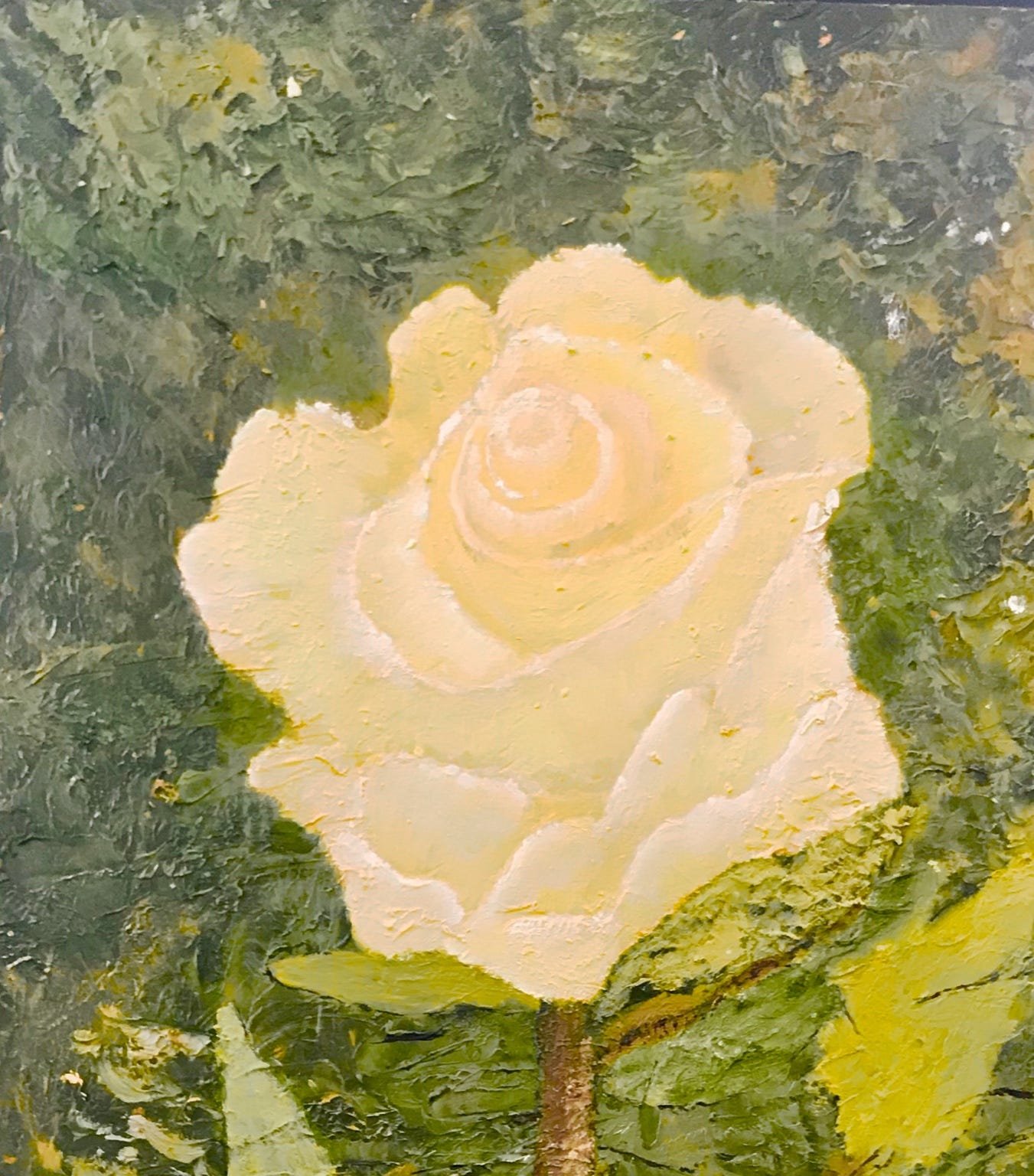
It was one I’d done about ten years ago — a commission — a single yellow rose against deep green, built up in thick oil, the petals almost glowing. I looked at it for a long moment before I understood why I’d stopped.
My mother loved yellow roses.
Her name was Rosalie. She was one of thirteen children raised by an old Cajun farmer in Louisiana, and her education ended in the eighth grade because her job was to work the fields. She carried whatever that cost her quietly, the way women of her generation carried most things — without ceremony, without complaint, without anyone asking how she was doing underneath it all.
But here is what Rosalie did with a life that handed her very little room to begin with.
She went to a technical school in our hometown and taught herself bookkeeping. From bookkeeping she learned the principles of business. From business she helped my father build a modest empire of car dealerships. And from there she walked into the American Business Women’s Association, became president locally, then regionally, and traveled to national conventions wearing her good suit and carrying herself like a woman who had always belonged in those rooms — even though nobody had ever told her she did.
I didn’t understand what she was showing me at the time. I was just a girl being dragged to meetings. But she was leaving an imprint I’m still living inside. I see almost everything through the lens of business. I always have. I thought that was just how my mind worked.
It was her. It was Rosalie, the whole time.
I remember coming home from marching band practice one evening, probably in my teens, and finding her standing at the pantry door with a long, slow sigh. The kind of sigh that has decades inside it.
I just get tired of trying to figure out what else I can cook for dinner.
She must have been in her late forties. And you could see it on her — the weariness she would never have named out loud, because back then nobody admitted to being tired. You just kept going. You whipped up dinner. You sat at the table. You made your church committee phone calls standing at the snack bar doing leg lifts because there was always something else on the list and you might as well work your legs while you worked your way through it.
I do leg lifts at the microwave now.
I never made that connection until today.
But the memory I keep coming back to — the one that has been sitting quietly in the back of my chest all afternoon — is from 1968. We’d gone to San Antonio, my mother and my cousin Kay and me. At some point my daddy wandered off on his own the way daddies do, and the three of us sat around eating ice cream cones, not thinking about much.
And then he walked back up, proud as punch, holding a papier-mâché yellow rose.
My mother’s face changed so completely it was like watching the weather shift. One moment ordinary afternoon. The next — the sun and the moon all in one. Daddy sang her a little bit of “The Yellow Rose of Texas” right there in the middle of wherever we were standing, and the entire energy of that trip changed in about thirty seconds.
A paper flower. A silly song. A man who knew exactly what his wife needed and went and found it.
I have been painting roses for years without fully understanding why.
Today I think I know.
Rosalie didn’t get a lot of papier-mâché roses. She got fields, and eighth grade, and dinner to figure out, and a world that asked her to be tireless without ever once asking how she was. She got a life that required her to find the door marked no and locate the way around it, every single time, without a map or a permission slip or anyone standing at the door saying you can do this.
She did it anyway. Quietly. Tenaciously. In her good suit, at her snack bar, with her leg lifts and her church calls and her face that could light up the whole world when somebody handed her something beautiful for no reason at all.
I am my mother’s daughter. I understand that more clearly today than I ever have.
And I think a lot of you are someone’s daughter too — daughters of women who were tired in ways they never named, formidable in ways nobody fully documented, tenacious in ways that are still living inside you whether you recognize them or not.
Maybe today isn’t about brunch or obligation or performing the right amount of feeling on the right day.
Maybe it’s just about pausing long enough to notice what they left inside you.
The thing you do without thinking.
The way you find the door around the no.
The leg lifts at the microwave.
The inexplicable pull toward yellow roses.
She’s still in there.
And if something in this piece made you pause, nod, or feel a little less alone — please give it a heart before you go. That one small tap tells the algorithm this conversation matters. It puts these words in front of another woman who needs to hear them today. She's out there. Help me find her.
And now you made me cry. On Mother’s Day. I sure remember my dear mom who always rustled up something for supper, even when she was dead tired from physical work at a nursing home or a factory and wife-ing and raising five kids. Sometimes it was bacon and pancakes because that was easy. We coulda, shoulda helped more. Today, I’m on my way to see my sweet daughter, who’ll treat me to a museum and dinner. I hope she remembers me as lovingly someday as you’ve remembered your dear Rosalie.
Thank you for this beautiful tribute. I think all of us who have lost our Moms cried a bit.