


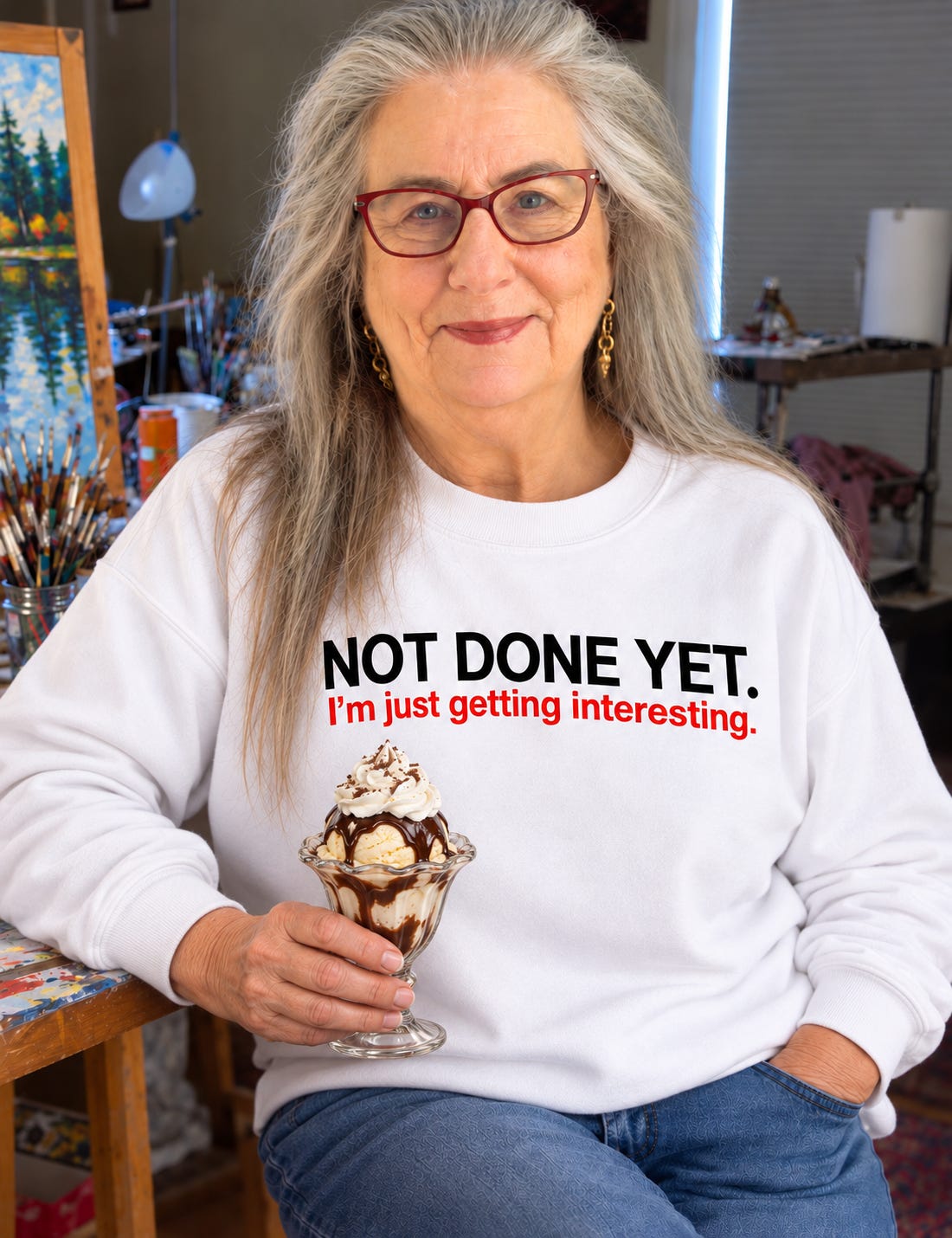
I Didn’t See You There
The sales clerk said it without thinking.
“I didn’t see you there.”
He wasn’t being cruel. He was being honest. One moment I wasn’t in his field of vision, and then I was — an older woman who had materialized from somewhere among the shirt racks to help a young man find the socks nobody else could locate.
“Where’d you come from?” the young man asked, genuinely puzzled.
I laughed. But I carried the question home with me.
Where do we come from? And more to the point — where did we go?
Women over 60 talk a great deal about invisibility. We say the culture stops seeing us. We say youth is valued and noise is rewarded and gray hair renders a woman somehow beside the point.
Some of that is true.
But I think we’ve been looking at the wrong disappearance.
Because the vanishing I’m most familiar with didn’t happen in public. It happened quietly, over decades, inside the ordinary days of a life organized entirely around other people’s needs.
For years — most of my adult life — I woke up with a list already running in my head before my feet hit the floor. Who needed what. What time the carpool left. Whether someone had a permission slip due or a dentist appointment or a particular kind of snack for a particular kind of occasion. The list was constant. The list was identity. The list was, in some way I couldn’t have named then, proof that I mattered.
And then one day — gradually, then all at once — the list went quiet.
Maybe yours went quiet differently. Maybe it was the last child leaving, or the marriage ending, or the job finishing, or simply a Tuesday when nobody needed anything and you didn't know what to do with your hands. The specific circumstances vary. The hollow underneath them doesn't.
The children grew. The marriage(s) ended. The house emptied. And into that silence came something I wasn’t prepared for.
Not freedom. Not yet.
First came the echo.
For a long time after my life changed, I left the house every evening between five and seven o’clock.
Not because I had anywhere to go. Because I couldn’t bear to be home at the hour when someone used to come through the door and say: hey mom, what’s for dinner?
Nobody was coming. But the body didn’t know that yet. The habit was deeper than thought — woven into the rhythms of decades, into the particular quality of late afternoon light and what it used to mean. So I drove. I ran errands that didn’t need running. I wandered through grocery stores not buying anything in particular, just moving through the hours until it felt safe to go home.
I’m not ashamed of that now. But I didn’t talk about it then because I didn’t have words for what I was grieving.
I was grieving usefulness. And usefulness, it turned out, had become the whole architecture of my sense of worth.
You may know this grief even if you've never named it. It doesn't announce itself. It arrives as restlessness, or a strange flatness, or the odd compulsion to stay busy in ways that don't quite satisfy. It's the grief of an identity that dissolved so gradually you didn't notice it going.
The phone calls slowed too — the ones from my adult children asking how to handle something difficult with their own kids, or how to make a proper roux, or what I thought about a decision they were facing. Those calls had been evidence. Evidence that I was still needed, still consulted, still relevant to the lives that had grown out of mine.
When they stopped coming as often, I didn’t deal with it directly. I just carried the phone with me everywhere, just in case. Prepared. Available. Waiting.
And then one day I recognized what I was actually doing.
I was organizing my entire sense of worth around whether my children needed something from me.
That was the moment the real question arrived: How do I feel worthy of my own existence when nobody needs me to do anything for them?
I didn’t have an answer. But I knew the question mattered more than any I’d asked in years.
If you've ever caught yourself wondering the same thing — how to feel worthy of your own existence when the roles that defined you have shifted or gone — then you already know this isn't a small question. It may be the most important one this chapter of life is asking.