


I Was Content. That Was the Problem.
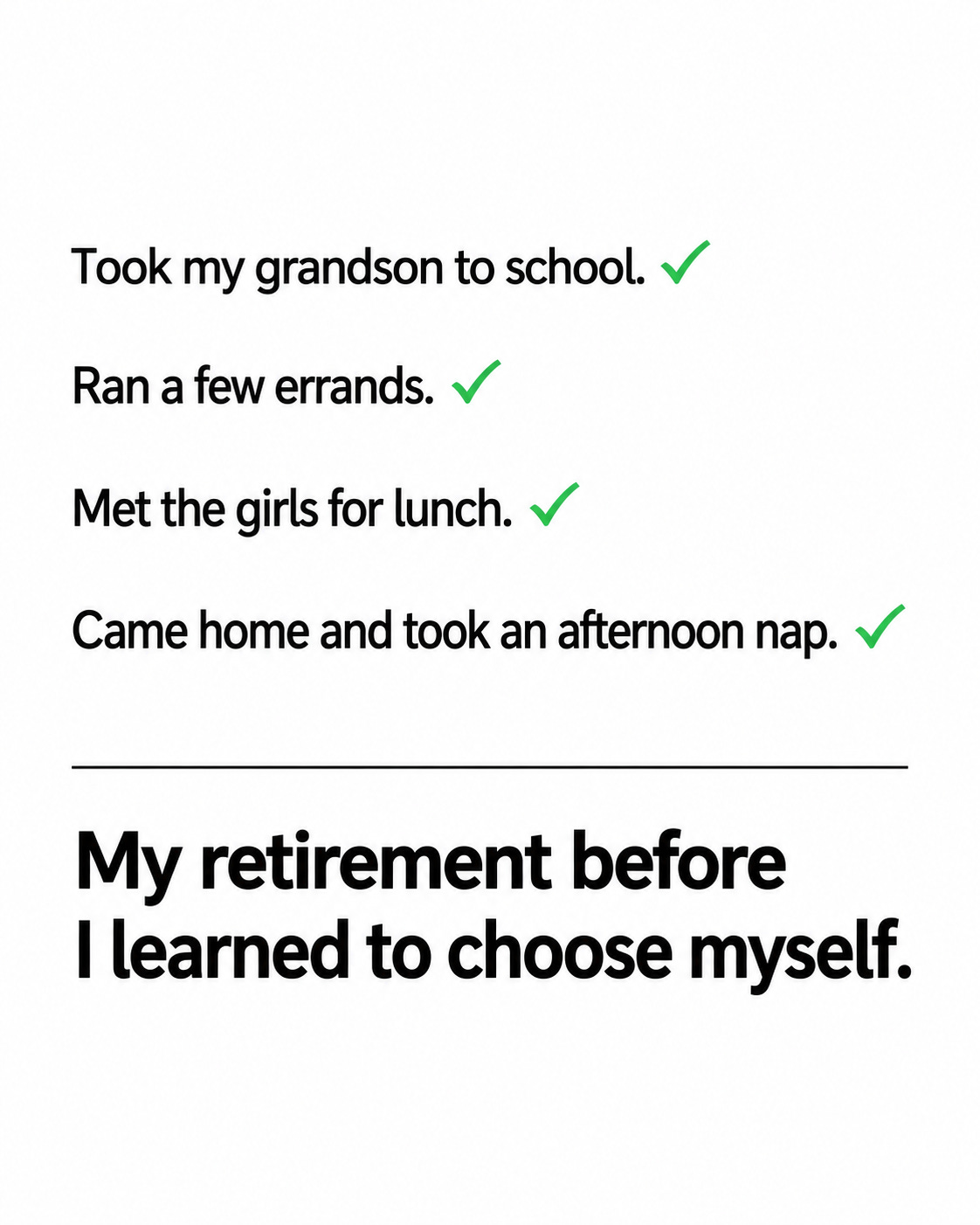
That was me at the beginning of retirement.
My days were pleasant. My calendar was full. I was content.
And somewhere inside, I kept hearing that old Peggy Lee song: Is That All There Is?

It was not unhappiness. That would have been easier to recognize. Nothing was terribly wrong. I had people I loved, things to do, and the freedom to arrange my days without a boss telling me where to be.
But there was a quiet gnawing underneath all that pleasant activity.
Something in me knew I had not come this far merely to fill the rest of my years with agreeable ways to pass the time.
I was content.
But I was not complete.
On a personal note — of all the posts I’ve written, this one is close to my heart.
I know this subject can make women defensive. Mention that retirement might hold more than grandchildren, gardening, lunch with friends, and an occasional trip, and someone will be along shortly to protect the afternoon nap as if I have arrived with a warrant to confiscate her pillow.
Relax. The nap is safe.
I am not saying those things are meaningless. They can be wonderful parts of a life. Some women retire, tend a beautiful garden, care for their grandchildren, exercise, travel when they can, and feel deeply satisfied. They have chosen a life that reflects what matters most to them, and it is enough.
If you can look at your life today, imagine living some version of it for another ten or twenty years, and feel your whole heart say, Yes, this is the life I want, then good for you.
Enjoy every damn minute of it.
This is not an attempt to drag a satisfied woman away from a life she loves. It is for the woman who loves much of her life and still feels something stirring beneath it.
She may be happy. She may be grateful. She may be surrounded by people she loves. Her days may be so full that her calendar needs its own blood pressure medication.
And still, in the occasional quiet moment, something inside her asks, Is this all there is for me?
That question is not ingratitude.
It may be the beginning of the most honest conversation she has ever had with herself.
I know because I had to have that conversation with myself.
The retirement that frightens me
I watched my brother-in-law choose a version of retirement that meant he had earned the right to do nothing. Every morning followed the same script: coffee, bacon and eggs, the enormous recliner, and television for the rest of the day. Occasionally he visited family. Then he returned to his chair.
He defended that life. This was retirement, he insisted. This was what he was supposed to do.
When he retired, he weighed around 200 pounds. By the time he died, diabetic, he weighed around 300.
I cannot say that contentment killed him. I can say that watching his world become smaller, more repetitive, and more sedentary left an impression on me I have never forgotten.
He had retired from his job. Somewhere along the way, he also retired from curiosity.
That is the retirement that frightens me.
So here is the question underneath everything I am about to say: is it safe to want more than a comfortable life — or does wanting more, at this age, make a woman ungrateful, greedy, or foolish?
I do not think it does. I think it makes her honest.
Retirement is more than leaving a job
We talk about retirement as though it happens when a company stops paying us to show up. You turn in your keys, clear out your desk, collect your little sheet cake, and walk into freedom.
But many women retire from employment without ever retiring from the expectations that have governed their lives. This holds true for the ladies who don’t have any family obligations, too — the tug at her soul is there the same as it is for the ones whose family tugs at her to be useful to them.
We remain available. We remain useful. We remain the emergency contact, the dependable grandmother, the family chauffeur, the keeper of appointments, and the woman who can always squeeze in one more thing because, after all, she is retired now.
Sometimes that is exactly what we want.
Sometimes everyone else’s needs rush in and claim the opening before we have even asked what we want.
Taking your grandson to school can be a choice made from love. It can also become the latest role you accepted before you had a chance to discover who you were without a role to perform.
Only you know which one is true.
Real retirement is not merely freedom from paid employment. It is freedom from automatically allowing other people’s expectations to determine the shape of your days, and freedom from the expectations of the generations before us.
It is finally having the right to ask, What do I want from the years ahead?
The math behind the question
According to the Social Security Administration’s current actuarial table, the average 65-year-old woman has another 20.66 years ahead of her. At 70, she still has an average of 16.76 years.
Many of us will live well into our 80s. Some will live into our 90s. A few will reach 100. The United States counted more than 80,000 centenarians in 2020, and nearly 79 percent of them were women.
That is not a little stretch of time to fill until the lights go out.
That is a future — the same length, give or take, as raising a child from birth to adulthood. Nobody would call that stretch of years a season to simply get through.
Not one lovely Tuesday with the grandson. Not one peaceful afternoon in the garden. Imagine thousands of Tuesdays. Imagine yourself five years from now, ten years from now, fifteen years from now.
Are you curious about who that woman might be?
What might fascinate her at 75 that she cannot imagine at 65? What might she create, question, learn, or become? What parts of her have never had enough room to emerge?
Or does she want the life she has today to remain essentially unchanged?
There is no universally correct answer. But after decades of answering to employers, husbands, children, parents, churches, communities, and everybody carrying an opinion about what a good woman should do, surely we owe ourselves an honest one.
Contentment isn’t the opposite of what I was afraid of. It’s the doorway to it.
I used to think the opposite of contentment was dissatisfaction. That if I wasn’t restless, I must be finished.
Here is what I understand now: contentment did not replace the gnawing. It is what let me finally hear it.
I could not hear a whisper while I was still striving, still proving something, still surviving one obligation at a time. Contentment was the quiet I needed before curiosity could get a word in.
Contentment says, I appreciate what I have.
Completion says, There is nothing left in me to discover.
Those are not the same declaration. One is a resting place. The other is a locked door. For years, I mistook the first for the second.
What the whisper sounds like
Purpose rarely crashes through the ceiling carrying written instructions. It begins much more quietly. A flicker of interest. A question you keep returning to. Something you want to learn for no sensible reason. A tiny impulse that says, Look over here.
My bestie, Greg, is proof of this. At 68, he got curious about growing food without land. He lives in a condo, in the same building as me. He couldn’t find the system he wanted, so he built one. Now he’s seeking a patent.
He didn’t sit around trying to discover his purpose.
He followed what fascinated him.
My own contentment has movement in it too. At 70, I am writing for thousands of women, building something that did not exist before I imagined it. I’ve expanded my oil painting practice to include subjects I am genuinely interested in, not what I think will sell. The level of satisfaction is enormous! I am asking better questions, discovering what interests me now, not what interested the woman I was at 40, and not what other people think should interest a woman my age.
And! I am conducting a little experiment for myself using a visualization technique combined with 4/4/6 breathwork. I’ll post about the results in about a week. I am fascinated by the power of our minds, so I am putting it to the test. I’ve nothing to lose, nobody will be harmed, and the fascination alone has generated a different level of energy in my body. So cool!
None of it arrived as a thunderbolt. All of it started as a whisper I finally had the quiet to hear.
What I know now that I didn’t know then
I used to believe contentment was the reward for a life well lived — the place you finally got to rest once everything else was handled.
I no longer believe that.
Contentment is not the finish line. It is the doorway into the part of the life you haven’t lived yet.
My brother-in-law found a kind of contentment too, in that recliner, in that routine. His mistake was not that he stopped working. It was that he mistook the doorway for the destination and never walked through it.
If contentment is enough for you, wonderful. This is not a summons to trade a peaceful retirement for another exhausting program of achievement. I am not handing women a fresh list of obligations and calling it liberation. We have had quite enough of that nonsense.
But if something inside you still whispers, Is that all there is? — do not bury the question beneath errands, lunches, grandchildren, travel plans, or another television program.
You do not need more things to do.
You need enough quiet to hear what’s still asking to be lived.
Listen.
Your future may be trying to get your attention.
The key takeouts
To recap, if you feel that tug in your spirit for something more, this is what I learned to do and what I urge you to try:
Notice what repeatedly catches your attention.
Remember what you once loved.
Give one curiosity some room.
Protect time that belongs to you.
Ask who you are curious to become.
You do not need more things to do.
You may need enough quiet to hear yourself and enough curiosity to follow what you hear.
Listen.
Your future may be trying to get your attention.
If You Feel the Tug, Follow It
If something inside you has been whispering that contentment is not the end of your story, I created a guide to help you listen.
REFOUNDATION: Rebuilding a Life That Can Hold You Now is a 21-page guided exploration of what still lights you up, what you left behind, and who you may still become.
You can purchase the guide for $17 on Gumroad, or become a paid member and receive it at no additional cost along with full access to The Daily RE-Wire. Bonus: Paid Subscriptions are currently 20% discounted
And if something in this piece made you pause, nod, or feel a little less alone — please give it a heart before you go. That one small tap tells the algorithm this conversation matters. It puts these words in front of another woman who needs to hear them today. She's out there. Help me find her.
Very interesting article. I miss reading many of your posts, yet, also, have read many. For me personally, this was the best. I’m 68, searching for more purpose for 12 yrs since I retired from a profession I loved…elementary teaching. Recently, have new visions, your post is great food for thought. Is there more to discover about ourselves? Are we still curious? The word retirement wasn’t a good word for me and turning 60 and being in the 60’s is really so different than any other time especially or including if you get divorced in your 60’s….what an unexpected journey….I’m finding my way…no wonder I read your posts. ❤️
One of your best Monica. I recognize so much of myself in your words. Thank you for sharing in your honest true voice.