


Who Decided Thanksgiving Had to Look Like This?
And why are we still following the rules?
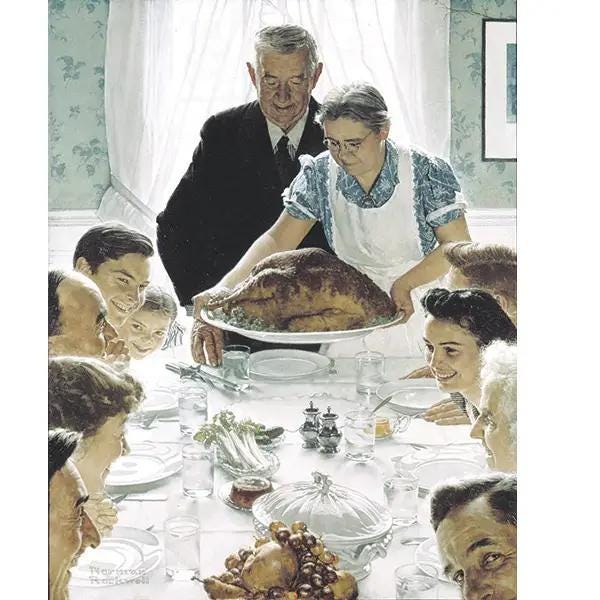
Take another look at Norman Rockwell’s 1943 painting Freedom from Want: the white tablecloth, the magnificent turkey, the smiling family, and a woman in an apron setting the bird down in front of them.
It’s a lovely painting.
And somewhere along the way, we turned it into an assignment.
Every November the advertisements arrive, the recipes appear, and television shows us families in immaculate homes, overflowing with happiness and gratitude. And women get busy, because somebody has to make sure everyone else has a wonderful Thanksgiving, and somebody always seems to be us.
So here’s the question nobody asks, usually because we’re too tired.
Why the hell are we doing all this?
If you adore the production, this isn’t about you, and you have my blessing. This is for the rest of us.
You know the moment I mean. It’s nine o’clock Thursday night, the roasting pan is soaking, the leftover pie is wrapped in foil, and the family has drifted to the couch. Somebody calls from the other room that it was a wonderful dinner. You say thank you and keep scrubbing.
Nobody sat us down and taught us this. The rules came the way they come to most of us, by watching. My mother and sisters ran the kitchen while the men watched football, and it was simply what women did. So at nineteen, pregnant with my first child, I cooked an enormous Thanksgiving dinner for my husband and me, and then I waited for everybody to show up. It never occurred to me that somebody had to invite them. I knew how to reproduce the meal. I had no idea how the people got there.
We ate leftovers for days.
Looking back, what strikes me is that nobody ever explained why we celebrated the way we did, asked whether I enjoyed it, or suggested there might be another way. Maybe nobody explained it to you either.
So why do so many of us keep going? I suspect that for generations of women, cooking the dinner offered something beyond feeding the family. It offered a chance to feel appreciated. The husband praises the turkey, the children compliment the pie, and everybody tells Mom what a wonderful dinner she’s prepared.
Mom beams.
Then she goes back to the kitchen to clean up.
Plenty of men help these days, and both my sons-in-law cook in their own kitchens. But there’s a difference between helping with the cooking and being the person responsible for making the holiday happen. I wonder how many women still carry that responsibility because they believe it’s part of how they earn their family’s love.
Here’s what the calendar won’t tell you.
We have a national holiday devoted to gratitude, and it was built in pieces. Sarah Josepha Hale, the editor of Godey’s Lady’s Book, campaigned for years to establish one. Lincoln proclaimed a national day of thanksgiving in 1863, in the middle of the Civil War. In 1939 Franklin Roosevelt moved it up a week to lengthen the Christmas shopping season, and Congress made it official in 1941, fixing it on the fourth Thursday, which is the only reason that date is on the calendar at all.
Commerce and Thanksgiving have been acquainted for a very long time.
You cannot manufacture gratitude.
You cannot command anyone to feel thankful because the calendar says it’s the fourth Thursday in November, and you cannot produce it with a Butterball turkey, a centerpiece from Hobby Lobby, and three kinds of pie. Gratitude is something we feel. Sometimes it arrives on an regular Tuesday morning when the sunlight comes through the window and we realize how much we love our lives. And sometimes it doesn’t arrive at all. That’s how feelings work.
The Thanksgiving my daughters still talk about, decades later, wasn’t a dinner. It was a freezing night in Manhattan, a thermos of hot chocolate, and a sidewalk near the Museum of Natural History where we watched the parade balloons being inflated. They don’t remember the turkey or the stuffing or a single elaborate dinner.
They remember what we experienced together.
Ask your own children or grandchildren which Thanksgiving they remember best. I’d wager it won’t be the one with the best tablecloth.
Now here’s the part of these traditions we rarely discuss.
This is the point where most writers would keep going. Instead, this is where I ask you to step inside.
The rest of this piece covers what happens when you test the disappointment you’re so sure is coming, why my children never once called in twenty years, and the one question worth asking yourself before Thursday. It’s for paid subscribers, because I’ve decided to stop giving my writing away.
Here’s what you get when you subscribe: me in your inbox a few times a week, writing about the things nobody told women over 60 they were allowed to question. Essays where you stop mid-paragraph and think, “That’s my kitchen.” It costs $7 a month, which is less than the turkey.