


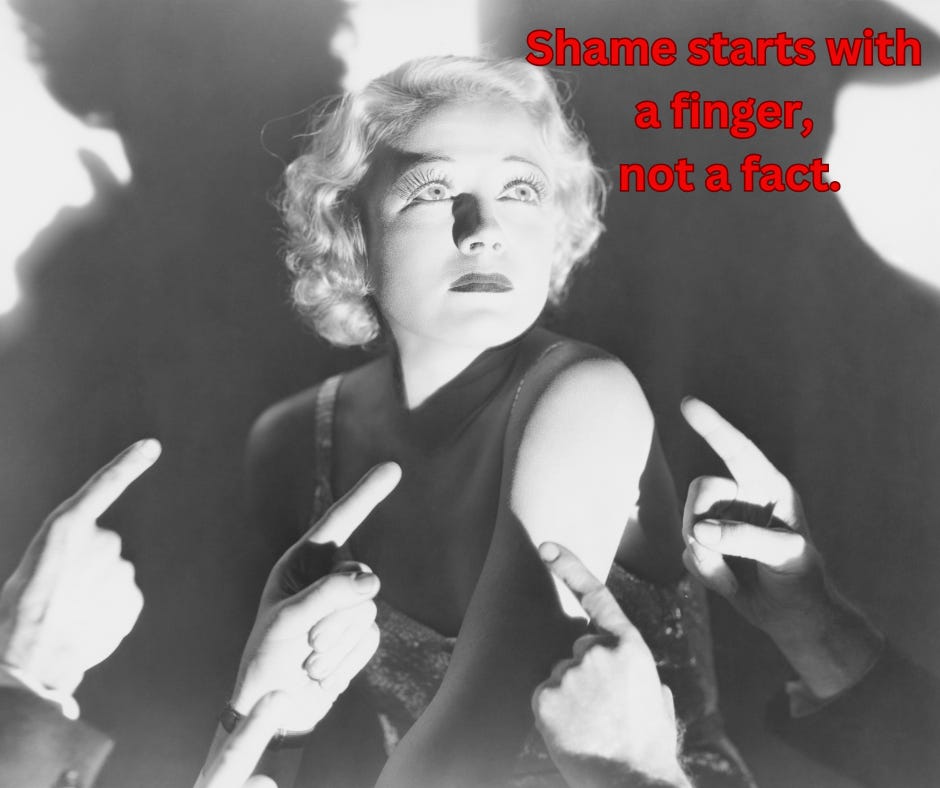
Part I: The Shadow We Carry
Shame is a quiet thief. It doesn’t announce itself like heartbreak or rage—it slips in unnoticed, weaving itself into the fabric of our lives so seamlessly that we think it’s just who we are. It tells us to be nice. To be small. To be quiet. It burrows deep, disguising itself as personality quirks, isolation, overachievement, people-pleasing, even success.
Unlike guilt, which says “I did something wrong,” shame says “There is something wrong with me.” And once that lie is planted, it colors everything—how we love, how we parent, how we age, how we dream. It becomes the lens through which we view our own worth, often without realizing we’re even wearing it.
For over sixty years, I wore that lens. And until recently, I didn’t know I could take it off.
Shame became my jailer long before I understood its name

It kept me inside invisible walls, whispering that I was different, that I didn’t belong, that I should be grateful for scraps and silence. It told me not to speak too loudly. Not to want too much. Not to show the parts of myself that felt strange, too sensitive, too needy, too bold.
It convinced me that safety meant smallness. That blending in was wiser than being seen. That my survival depended on keeping quiet about the thing that marked me. And so, like so many women shaped by quiet traumas and polite expectations, I built a life inside that cage—decorated it, even loved parts of it—without ever realizing I had the key in my pocket the whole time.
Part II: The Life Shame Built
I know exactly when shame came to live inside me. I was six. Something happened that never should have. A trusted adult in my family crossed a boundary that changed everything. It wasn’t a misunderstanding. It wasn’t confusion. It was wrong. And I knew it. Not in my mind—but in my body, my breath, my bones.
But no one talked about it. No one told me I was safe. No one said it wasn’t my fault.
So I stayed quiet. And in that silence, shame found its way in.
Not guilt—guilt is about something you do. This was different. This was the belief that I was wrong. That I was the reason for what happened. That if anyone found out, I’d be rejected or blamed or worse.
So I carried that belief with me. Into my teens. My marriage. My motherhood. It shaped everything—my voice, my choices, my worth.
But looking back now, I realize shame had already found a crack to crawl into—long before that moment at age six.
The story of my birth was often told with a chuckle, but I absorbed it differently.
I was the “uh-oh” baby. The mistake. The pregnancy my mother tried to hide.
Born seventeen years after my oldest brother and eight years after the next closest sibling, I was the one they hadn’t planned for, hadn’t expected—maybe hadn’t even wanted.
I grew up hearing that story told at cookouts and family gatherings. People laughed.
But I didn’t.
Because underneath the laughter was a message I carried quietly for decades:
“You weren’t supposed to be here.”
There’s a particular memory that still visits me sometimes. I was driving through a quiet cul-de-sac, going to visit someone. It was the kind of neighborhood you’d see in a family sitcom—trimmed lawns, wind chimes, basketball hoops, dads mowing the yard, moms in the kitchen, kids on bikes weaving lazy loops in the street.
And I remember this sharp ache rising in my chest. Not envy, exactly. Not longing, even. More like... displacement.
Why couldn’t I have that?

Why did that version of family, of belonging, feel like something other people were allowed to have—but not me?
I was married to the preacher at the time. We lived in the parsonage—a house assigned to us by the church, never truly ours. He showed up for meals. For sermons. For the congregation. But not for us. Not for me.
And in that cul-de-sac, surrounded by scenes of ordinary joy, I felt like a stranger looking in through the glass. I told myself I was just jealous. Just tired. Just imagining things.
But now I know. It was shame.
It was shame whispering, “You’re not like them.” “You’re not good enough for that kind of life.” “Something in you disqualifies you.” And I believed it. I swallowed it. I wore it like an invisible uniform and tried to move through life without asking for too much.
That day in the cul-de-sac? That wasn’t a random pang of jealousy. That was shame showing its hand. And I see it now for what it was: a lie I inherited, a lie I carried, and a lie I’m no longer willing to keep.
Part III: The Reckoning
The moment of clarity didn’t come in a dramatic breakdown. It came while watching a video. Just a few minutes of someone explaining the difference between guilt and shame—and something inside me cracked open.
I paused it. Rewound it. Watched again.
Shame says: I am a mistake. Guilt says: I made a mistake.
And right then, I knew: I’d been carrying shame my entire life, but calling it guilt.
I had apologized to both of my daughters more than once. I had done therapy. I had read the books, meditated, journaled, led others in healing. But deep inside, something still throbbed. And now I understood why.
It was never guilt. It was never about what I did. It was about who I believed I was.
And finally naming that? It didn’t erase the pain. But it took the poison out of it. Relief. And Free.
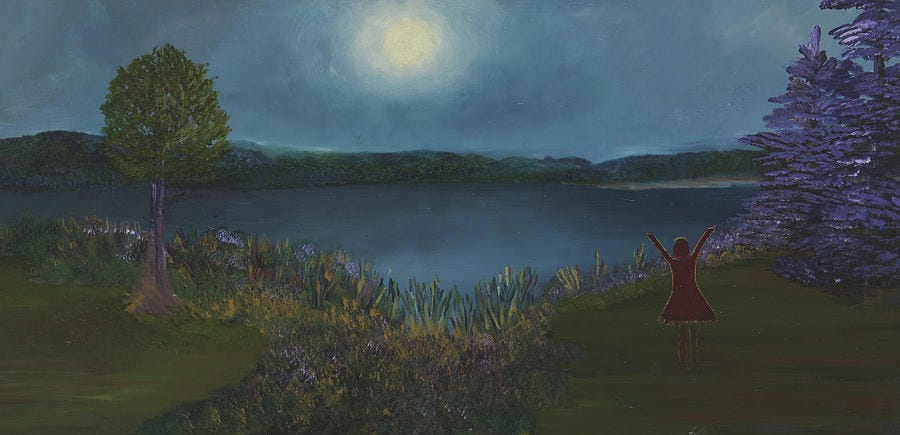
That’s when I started mourning my own life. Mourning all the years I spent trying to be lovable by being small. Mourning the moments I held back, isolated, created a persona that others could accept without ever seeing the real me. Mourning the way shame tricked me into thinking I had to earn my place in the world.
Part IV: The Key in My Pocket
Here’s what I know now: I didn’t isolate because I hated people. I isolated because I didn’t trust myself to withstand the shame. I didn’t believe I could enter a room without being found out. So I stayed home. It felt safer than crumbling under the weight of being seen.
Shame made me believe that being an artist would give me cover—because artists are odd, right? We’re allowed to be moody, private, hard to reach. And I used that like a shield. It let me move through the world without having to explain why I couldn’t fully show up.
But now? I understand. Those "odd" choices, the self-sabotage, the hiding—they weren’t just quirks. They were all symptoms of that root wound.
And the moment I named it? I found the key. The key to my cage had been in my pocket the whole time.
I’m not wrong. I was hurt. I’m not broken. I was silenced. I’m not disqualified. I was lied to.
Part V: A Love Letter to the Women Who Know This Pain
To the woman who still believes she has to shrink to survive—this is for you.
To the woman who built an entire life around being acceptable but never felt truly seen—this is for you.
To the woman who still carries a knot in her belly every time she takes up space, asks for more, or dares to dream—this is for you.
It wasn’t your fault. You didn’t cause it. And you don’t have to carry it anymore.
The lie that kept you small is just that—a lie. And once you name it, it starts to lose its grip.
The dream is not foolish. The longing is not too late. There is nothing wrong with you.
You were never meant to live inside a cage of shame. You were always meant to fly.
With love and truth,
Monica
You made it to the end of this story—mine, and maybe yours too.
THANK YOU!
If you felt seen here, it’s because you are.
If you’ve been carrying something nameless, I hope now it has a name.
If you’ve ever wondered whether you were broken, I’m here to tell you: you’re not.
You are still becoming. Still worthy. Still whole.
And you are not alone.
🌿 “If these words touched a place you thought forgotten, stay awhile.”
🌿 “If something in you exhaled as you read, come sit with me again.”
🌿 “If this felt like a remembering, let’s keep remembering together.”
🌿 “Let these words be a lantern. Subscribe, and walk with me a little longer.”
I wish I could pick a quote to put here, to signify the highlight that spoke to my soul, but I’d just be copy and pasting the whole post. Wow! Thank you for sharing. Reading more people talk about their experience with shame, no matter the factors that caused it, have really helped me feel less isolated in unpacking my own. It’s a brutal journey, but it gives me hope along the way. This was so beautifully and prophetically written!
This is beautifully written and so vulnerable and spot on accurate on the difference between shame and guilt. Our shame keeps us captive until we release its hold. Thank you for sharing this important piece of writing and of your journey.