


December, 1973 - Two weeks before my wedding, I told my father I did not want to get married.
I was 18. The man I was supposed to marry was nine years older than I was and studying to become a preacher. My parents were thrilled about the marriage. Having a preacher in the family would elevate our standing in the social circles we occupied.
That was a lot of weight to place on an 18-year-old young lady.
I went to my father and told him plainly, “I really don’t want to do this. Don’t make me do this.”
My father flew the groom from seminary at TCU in Fort Worth, Texas, to Lake Charles, Louisiana, so the three of us could sit down and settle the matter.
Once again, I said I did not want to get married.
My father slammed his hand on the coffee table, proclaiming “You will not embarrass this family.”
And that settled it.
I did not have the confidence or courage to stand up to him. I had tremendous respect for my father. There may have been fear mixed into that respect, but mostly I understood that good girls did what their fathers told them to do.
So I got married.
Later, I overheard my father explaining my resistance to other members of the family.
“She’s just too young,” he said. “She doesn’t know better.”
Let that sink in for a minute.
I was supposedly too young to know that I should not marry this man, but old enough to marry him anyway.
I had not been confused. I knew exactly what I wanted. More importantly, I knew what I did not want.
I said it clearly.
But my knowledge of my own life was given less authority than the rule that said a good daughter must not embarrass her family. That rule altered the course of my life.
After two failed attempts at asking for a divorce, the third attempt finally was accepted — only because I felt so hemmed in that I fled to NYC the moment the opportunity presented itself, and I grabbed it with all the gusto I could summon. I became a professional classical music producer, publicist, and manager.
And here is where my initiation into breaking rules began — though I feel certain the idea of questioning everything had always been within me, dormant until the actual breaking of the rules occurred. Through the process of writing/ composing music, recording the music and photo shoots for the CD cover, the very idea of breaking rules came alive. It did require a beautiful set of feet and a willing classical pianist. And of course the Steinway Piano.
In collaboration with a pianist named Bob Dawson, who also happened to be my husband, we created and produced an album called Breaking the Rules
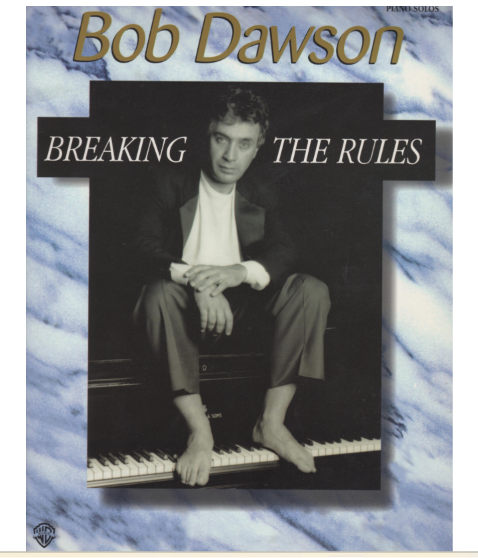
.It broke the most basic rule of music production and sales: stick to one genre. We refused, and there it was — a rule broken.
We included classical, pop, and the kicker: bluegrass on piano, which is basically combining Chopin with Mozart with a little Liberace pizzazz for good measure.
Everyone in the music business warned me that putting three distinctly different musical styles on one solo piano album was unwise, to say the least.
I did it anyway.
Why not?
We took the program on tour with some success. Billboard magazine even wrote an article about me and what we were doing.
The project eventually culminated in a photograph of Bob sitting barefoot on the keys of his Steinway piano.
If you know anything about classical pianists, you know that putting your bare feet on a Steinway is practically an indictable offense.
The photograph broke the rules before anyone heard a single note.
It also received more attention than the album did. Bob got attention from it, I got attention because I created it, and the photographer got attention — the album itself did not generate much revenue for anybody.
Breaking the rules does not always produce the outcome you imagined.
Sometimes you break the rules, create something completely original, have a hell of a good time, and still do not make much money.
Instead an opportunity presented itself via PBS. This was before 9/11, when the world and our lives looked very different.
To protect the intellectual property, we trademarked the phrase Breaking the Rules.
For reasons I still do not understand, the trademark had to be classified as children’s education.
Talk about a rule that needed to be broken.
I believe Bob still owns the trademark. I gave up my rights to everything in the divorce, so legally, the phrase no longer belongs to me.
But I kept the instinct behind it.
Before I follow a rule, I want to know who made it, why it exists, and whether it deserves any authority over my life.
That little girl inside me will not stop asking why.
I am grateful for her.
The Rules We Carry With Us
At 70, the rules I find myself questioning are not usually imposed by the classical music industry or enforced by trademark law.
They are smaller now.
What time am I supposed to take my vitamins, how long are dishes allowed to remain in the sink, what time should I get dressed, how much must I accomplish before I am permitted to spend the afternoon painting, and if I did something yesterday, am I required to do it again today?
Why? Who made that rule? And who the hell cares if I do not follow it?
The problem with making rules for myself is that every rule eventually becomes another opportunity to judge myself.
If I follow it today, I have been good — and if I do not follow it tomorrow, I have failed.
Suddenly, I have turned my life into one endless performance review, complete with a disapproving supervisor who lives inside my own head.
I have spent enough of my life being told what a good woman does. I have no intention of becoming my own parole officer now.
Some things still need to be done. Bills must be paid. The dog must be fed. We need clean clothes occasionally, and leaving food stuck to the dishes indefinitely will eventually produce consequences.
Those are practical realities.
They are not measures of a woman’s goodness.
Doing the dishes does not make me virtuous. Leaving them until tomorrow does not make me defective.
What Does a Good Woman Do?
Women have inherited an enormous collection of rules about what makes a good woman.
A good woman does not embarrass her family, puts everyone else first, finishes her responsibilities before she plays, does not waste money on foolish dreams, is grateful for what she has and does not keep wanting more, acts her age, does not draw too much attention to herself, is practical, and does not become consumed by some new ambition after retirement.
My God, who wrote these rules?
More importantly, what have they cost us?
How many women gave up painting because art supplies seemed like an indulgence, stopped writing because nobody had given them permission to call themselves a writer, abandoned music, travel, business ideas, education, love, pleasure, or adventure because pursuing those things would have inconvenienced someone else, were told they were too old, too inexperienced, too impractical, too selfish, or simply too late, or learned to call obedience contentment?
Then we reach 60 or 70 and wonder why we cannot remember what we are passionate about.
It is likely our passion did not disappear.
It is probable we became so practiced at overriding it that we can no longer hear it.
Every time passion spoke, somebody called it selfishness, foolishness, irresponsibility, or disobedience.
Passion Does Not Follow a Timetable. Consider Grandma Moses. She began painting seriously at 78. At 80, she had her first solo exhibition in New York City.At 93, she appeared on the cover of TIME magazine.
The accepted timetable for becoming a famous artist had already expired decades earlier. According to the rules, she should have been quietly winding down.
Instead, she painted.
She did not organize her remaining years around what society thought an elderly woman should do. She organized them around what made her feel alive.
Why isn’t passion the baseline for living a good life?
Why do we ask one another, “How are you doing?” instead of asking, “What are you passionate about today?”
Imagine asking a woman that question and waiting long enough for the real answer — not what she needs to finish, not who needs something from her, not how she is feeling physically, but what is stirring inside her, what she can hardly wait to begin, and what she once wanted that she was persuaded to put away.
Question the Rule
I am not suggesting that every rule should be broken.
I am suggesting that every rule is eligible for questioning.
Who made this rule? What is it supposed to protect? Who benefits when I obey it? What has obeying it cost me? And what might come alive if I stopped?
The purpose of questioning the rules is not to create chaos. It is to find out whether your passion has been buried underneath them.
Breaking the rules does not guarantee success. That album taught me that.
It does not guarantee money, applause, approval, or a feature on PBS.
It guarantees something else.
It gives you the chance to discover what you would choose if obedience were no longer the highest measure of your goodness.
I once owned the legal rights to the phrase Breaking the Rules.
I do not own them anymore.
But perhaps the phrase has been mine in a much deeper sense for most of my life.
At 18, I knew what I wanted, but I followed the rule.
At 70, I am far more interested in following what makes me feel alive.
Before you decide that you have lost your passion for life, ask yourself one question:
Which rule required me to abandon it?
And if someone ever figures out how to bottle passion, I want a case of it.
Until then, I suppose we will have to make our own fresh, every morning.
You don't need a Steinway, or a wedding you didn't want, or an album nobody thought would sell. You just need one rule you've never actually questioned. Find it. Ask who made it, and what it's cost you. That's the whole assignment — the answer is yours to keep.
Recognizing the old rule is one thing. Refusing to obey it any longer is where the fun begins.
Paid membership includes the Breakthrough Group, where we talk honestly about the beliefs we inherited and decide which ones deserve to be thrown straight into the rubbish. Loads of emotionally support is available to all the women.
You’ll also receive my member perks, a growing collection of original art, writings, and exercises created for women over 60 who are ready to want, choose, create, change, begin, and become.
👉 Join us. You are not done yet.
And if something in this piece made you pause, nod, or feel a little less alone — please give it a heart before you go. That one small tap tells the algorithm this conversation matters. It puts these words in front of another woman who needs to hear them today. She's out there. Help me find her.
PS: Many of you have seen the collection of NOT DONE YET shirts via my notes feed on Substack. Here’s the link to grab one :
https://i-am-not-done-yet.printify.me/

I know not everyone wants another monthly or annual subscription hanging around like a houseguest who won’t leave. Sometimes an article simply hits home, rattles something loose, or says exactly what you needed to hear. If that happens, you can buy me a coffee as a one-time way of saying, “That one got me.” I appreciate you, and I’m delighted that my peculiar arrangement of words found its way to you.
I agree. Who made the rules and why? I was fortunate to have a very nonconventional Mom and it gave me probably more freedom to choose. Though those "follow the rules" guidelines were also installed through society, advertising, social mores.
I have no idea what I am passionate about because after finally retiring I am tired. And trying to find my way back to me outside of all the expectations to show up to work and play the role. I have given myself permission to rest and regroup. Then it will become more visible. Thank you for this article!
Wow! This was powerful! To speak your mind so clearly at 18 and have a patriarchal father shut you down. Yup, women’s liberation still had chains.
And…Breaking the rules! What amazing freedom.
Rules…they need to be argued, they need to be weighted and measured. Rules do not fit all circumstances. Perhaps we need guides, not rules.